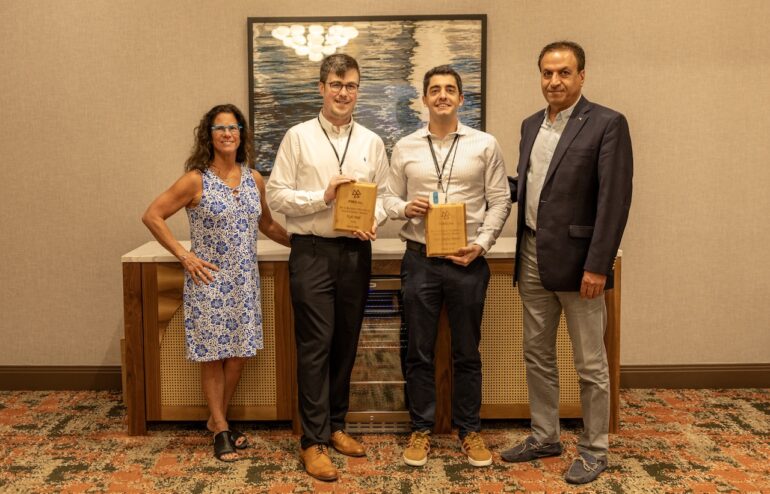
PDES, Inc. is pleased to announce that Juan Carlos Mendo (The Boeing Company) and Kyle Hall (Airbus) have been selected as the co-recipients of the 2026 Brad Rigdon Technical Management Award. This award recognizes individuals who demonstrate exceptional technical management in executing complex PDES, Inc. programs and honors the legacy of Brad Rigdon, whose leadership helped advance STEP from early development to global implementation.
For the first time, there are co-recipients who are co-leaders in the Model-Based Systems Engineering (MBSE) project. Juan Carlos Mendo and Kyle Hall have worked in close partnership to guide one of the most complex and strategically important initiatives within PDES, Inc. As co-leaders, they have demonstrated that effective technical management is not only about execution, but also about building alignment across diverse organizations and disciplines.
Through their leadership, the MBSE Working Group has successfully brought together a broad network of standards development organizations, including PDES, Inc., ISO, OMG, prostep ivip, Modelica, and INCOSE. Their ability to coordinate across these communities—each with its own processes, priorities, and timelines—has enabled meaningful progress toward addressing critical challenges in MBSE interoperability and long-term data preservation.
A key milestone achieved under their leadership is the completion and external ballot submission of LOTAR Part 500, which establishes foundational concepts for the long-term archiving and retrieval of MBSE information. This accomplishment reflects not only strong technical direction, but also disciplined planning, coordination, and execution across a highly distributed team.
Juan Carlos and Kyle have also demonstrated exceptional skill in managing complex technical efforts by effectively leveraging the expertise of a diverse team. They consistently assign responsibilities to the most qualified contributors, anticipate and mitigate challenges related to multi-organization collaboration, and maintain clear, realistic roadmaps that keep work aligned with strategic goals. Their proactive communication and thoughtful coordination ensure that progress continues even in the face of competing schedules and resource constraints.
Equally important is their commitment to fostering a collaborative and inclusive team environment. They are widely respected for their professionalism, fairness, and ability to bring out the best in team members. By encouraging open dialogue, recognizing contributions, and maintaining a positive and engaging atmosphere, they have built a high-performing team that delivers impactful results for the broader MBSE community.
Their combined leadership, technical insight, and dedication exemplify the spirit of the Brad Rigdon Technical Management Award. Together, Juan Carlos Mendo and Kyle Hall have demonstrated how strong partnership and effective management can drive progress on some of the most challenging technical initiatives within PDES, Inc. PDES, Inc. congratulates Juan Carlos Mendo and Kyle Hall on this well-deserved recognition and thanks them for their continued leadership and contributions to advancing model-based systems engineering and interoperability.