The LOTAR International Project (Long-Term Archiving and Retrieval) is a global industry initiative dedicated to developing standardized methods for preserving and retrieving digital product and technical information over the long term. Jointly hosted by AIA and PDES, Inc. in the US, as well as ASD-STAN and prostep ivip in Europe, LOTAR enables companies to archive engineering, manufacturing, and product lifecycle data in neutral formats that remain accessible and reusable despite future changes in software platforms and information technologies. Its standards ensure the long-term availability, authenticity, and interoperability of critical digital product data throughout the lifecycle of complex products.
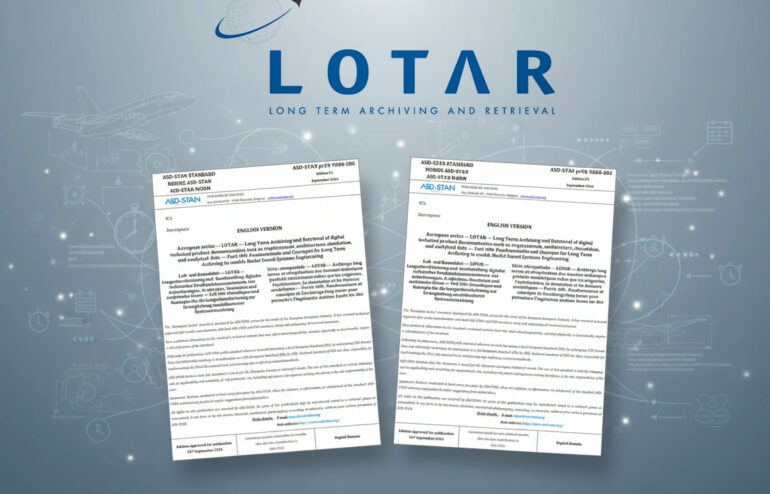
Over the past four months, the LOTAR community has achieved a significant milestone with the publication of several new and updated parts of the EN/NAS 9300 Series. These publications expand the industry’s guidance for long-term preservation of digital engineering data and reflect the growing scope of digital transformation across product lifecycle management, model-based engineering, and systems engineering disciplines.
Newly Published Standards
- EN/NAS 9300-002 – Requirements for Long-Term Archiving and Retrieval of Digital Product Information
This foundational document defines the business, legal, regulatory, and technical requirements for preserving digital product data over extended periods. It establishes the principles and processes needed to ensure that archived information remains accessible, understandable, and usable throughout a product’s lifecycle. - EN/NAS 9300-110 – CAD 3D Explicit Geometry Preservation
Part 110 specifies requirements for the long-term preservation of 3D explicit geometry for individual CAD parts. The updated standard defines the essential information, validation methods, verification rules, and quality checks required to preserve geometry accurately and enable reliable retrieval in the future. - EN/NAS 9300-205 – Product Structure Validation
This new document addresses validation of archived product structures within Product Data Management (PDM) environments. It introduces methods for uniquely identifying product structure elements and validating archived structures through attribute- and relationship-based verification techniques, helping ensure data integrity and reusability. - EN/NAS 9300-500 – Fundamentals and Concepts for Model-Based Systems Engineering (MBSE) Archiving
Part 500 provides the foundation for archiving MBSE data represented as digital models. As the first document published in this domain, it covers a broad range of systems engineering artifacts, including requirements models, functional and logical architectures, simulations, verification and validation models, and system trade studies. The standard establishes the concepts needed to preserve complex model-based engineering information for future access and reuse.
The published documents can be obtained via ASD-STAN or AIA.
Why These Publications Matter
As aerospace, defense, and other advanced industries continue their transition toward model-based engineering and fully digital product development, preserving engineering knowledge becomes increasingly critical.
For PDES, Inc. member organizations, these new EN/NAS 9300 publications strengthen the standards foundation needed to support the Digital Enterprise. They provide practical guidance for preserving and validating digital engineering information, helping organizations maintain interoperability, reduce the risks of technology obsolescence, and ensure that critical product data remains accessible and reusable over the long term.
By advancing internationally harmonized approaches to long-term archiving, these standards directly support the PDES, Inc. mission of enabling enterprise integration, lifecycle interoperability, and standards-based product data exchange across industry, government, academia, and software communities.
What is Coming Next
The LOTAR team continues its work on new and updated documents within the EN/NAS 9300 series standard. In addition to revised versions of Part 005 (Authentication and Verification) and Part 200 (Fundamentals & Concepts for Long-Term Archiving of PLM Information), first releases of the new Parts 021 (Meta Data for Archive Packages), 230 (“As Delivered/As Maintained” Product Structure) and 300 (Fundamentals and Concepts for Long-Term Archiving of Composite Material Definitions) are planned over the next few months.