
Author: Jochen Boy

27 Feb 2026

INCOSE recognizes Working Group Supporting MBSE Collaboration

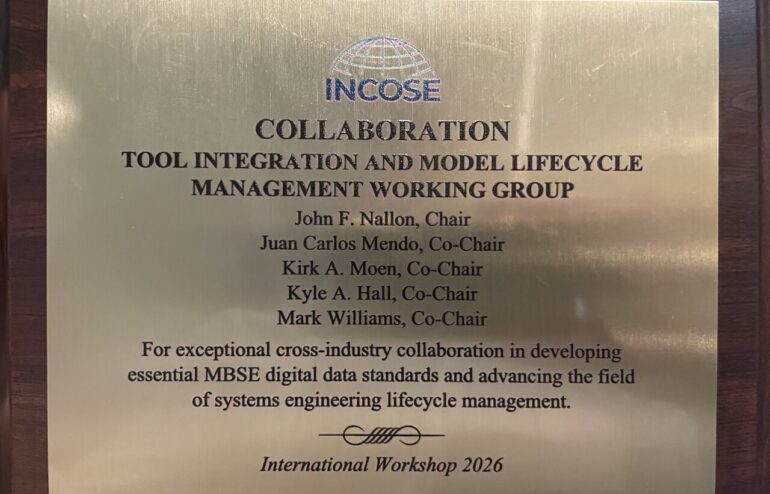
Juan Mendo of Boeing, who leads the PDES, Inc. Model-based Systems Engineering (MBSE) project, and John Nallon of INCOSE, along with their  colleagues were honored for their contributions to INCOSE’s Tool Interoperability and Model Lifecycle Management (TIMLM) Working Group, which is focused on strengthening the foundations of systems engineering in an increasingly digital and model-driven environment. Honorees were John Nallon, who chairs the TIMLM working group, Kyle Hall of Airbus, Juan Mendo of Boeing, Mark Williams (ret. Boeing), and Kirk Moen of Boeing.

In a LinkedIn post, Mendo pointed out that the proliferation of digital standards presents both opportunity and risk and the importance of collaboration to exploit the opportunities and mitigate the risks.

This award exemplifies the spirit of collaboration that PDES, Inc. values—bringing together diverse stakeholders to advance interoperability, reduce fragmentation, and enable faster, more effective digital transformation. The PDES, Inc. and INCOSE memorandum of understanding helps solidify the collaboration between the two organizations.

John Nallon, Kyle Hall, and Juan Carlos Mendo accepting the award on behalf of the entire team

Congratulations to the TIMLM Team

PDES, Inc. congratulates Juan Carlos Mendo and the entire TIMLM Working Group on this well-deserved recognition. Their work highlights the importance of cooperation across standards communities and reinforces the role of PDES, Inc. as a trusted forum for advancing model-based engineering and systems interoperability. The MBSE project brings together organizations such as OMG, prostep ivip, Modelica and others to collaborate to ensure that model-based systems engineering standards are aligned, interoperable and ready for real-world implementation.
17 Feb 2026

Persistent IDs and Traceability

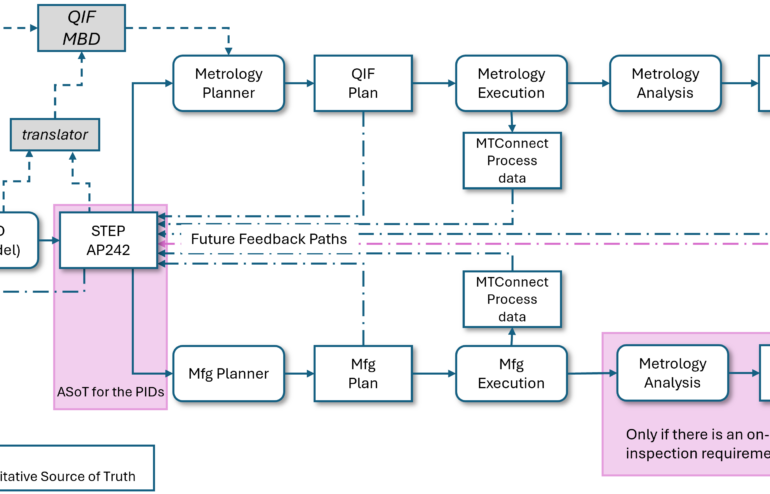
In the era of Model-Based Definition (MBD), establishing seamless traceability from design intent through manufacturing to quality inspection has become essential. Traditional manufacturing workflows often break the connection between design specifications and inspection results. When a part fails inspection, engineers struggle to trace the failure back to specific design requirements.

This challenge is addressed by implementing Persistent Identifiers (UUIDs) that maintain identity across system boundaries, as documented in the “Recommended Practices for Cross-Domain Exchange for Downstream Uses“, jointly published by DMSC and the CAx-IF.

The STEP standard uses V5_UUID_ATTRIBUTE (namespace-based, repeatable UUIDs) to tag geometric entities and PMI elements. QIF files preserve these identities through EntityExternalIds, creating a robust linkage mechanism that survives data translation between CAD, CAM, and CMM systems.

Research validated by CAx-IF testing demonstrated that Persistent ID-based traceability between STEP and QIF is achievable and practical. The combination of V5_UUID_ATTRIBUTE in STEP files and EntityExternalIds in QIF provides a robust, standards-compliant mechanism for maintaining the digital thread from design through inspection. With proper implementation following established rules and patterns, 100% traceability success is attainable, enabling true Model-Based Definition workflows where design intent flows seamlessly to quality verification.

02 Feb 2026

Global Product Data Interoperability Summit 2026

Intelligent Interoperability: Harnessing AI to Unite the Digital Manufacturing Ecosystem

As manufacturing organizations accelerate their adoption of digital engineering, the ability to seamlessly exchange and interpret product data across the lifecycle has long been a strategic imperative. Artificial Intelligence is increasingly shaping how digital artifacts—from system models and product definition to manufacturing and sustainment data—are connected across tools, organizations, and domains. When applied effectively, AI can enhance interoperability by automating data alignment, resolving semantic inconsistencies, and enabling intelligent reuse of authoritative digital engineering assets across the enterprise. When applied poorly, AI can hallucinate, mislead, and damage.

This year’s Global Product Data Interoperability Summit will examine the role of AI in advancing standards-based interoperability within enterprise digital ecosystems. We will focus on how AI can augment model-based systems engineering, digital twins, and manufacturing execution by improving data consistency, traceability, and decision fidelity across design, production, and operations. The Summit will also address the challenges of integrating AI into existing data standards, reference architectures, and governance frameworks to ensure trust, repeatability, and lifecycle continuity.

By bringing together leaders from digital engineering, manufacturing, and standards communities, the Summit will provide a practical and forward-looking forum to assess how Artificial Intelligence can be responsibly leveraged to strengthen interoperability at scale. The objective is to enable resilient, model-centric manufacturing environments where AI-driven insights are grounded in standardized, authoritative data—supporting faster innovation, improved quality, and more agile production in an increasingly complex global landscape.

More information will follow regarding abstract submission, sponsorship opportunities, hotel reservations, and summit registriaion!

–> Visit the Website